
Storing health records in a PIPEDA-compliant manner means protecting patient data through federally mandated consent, technical safeguards, and alignment with provincial health information laws. The Personal Information Protection and Electronic Documents Act (PIPEDA) is Canada's federal private-sector privacy law, and it governs how organizations collect, use, and disclose personal health information. For Canadian healthcare providers, compliance is not optional. The Office of the Privacy Commissioner of Canada enforces PIPEDA, and provincial regulators enforce parallel legislation like Ontario's Personal Health Information Protection Act (PHIPA) and Alberta's Health Information Act (HIA). Getting this right requires understanding both layers of law, not just one.
What are the essential requirements to store health records PIPEDA compliant?
PIPEDA is built on ten Fair Information Principles, and several apply directly to health record storage. The most critical are accountability, consent, limiting collection, safeguards, and individual access. Each principle carries specific obligations for how your clinic handles patient data from intake through deletion.
Meaningful patient consent is mandatory before disclosing personal health information to any third party, including AI vendors, under PIPEDA Principle 4.1.3. That means a patient must understand what data you collect, why you collect it, and who can access it before they agree. Consent buried in a general intake form does not meet this standard.
Provincial laws frequently impose stricter requirements than PIPEDA alone. Ontario's PHIPA requires health data to be stored within Canada and mandates detailed breach reporting obligations. Clinics operating in Ontario, Alberta, or British Columbia must satisfy both federal and provincial rules simultaneously. Providers often overlook this dual-compliance requirement, which creates gaps that regulators find during audits.

The financial stakes are real. Quebec's Law 25 imposes penalties up to C$25 million for mishandling sensitive personal information. That figure applies to organizations of any size, including small clinics. Compliance is not just a legal formality. It is financial risk management.
Pro Tip: Map every point where patient data leaves your clinic, including appointment reminders, intake forms, and AI-generated reports. Each transfer point requires its own consent disclosure and vendor agreement.
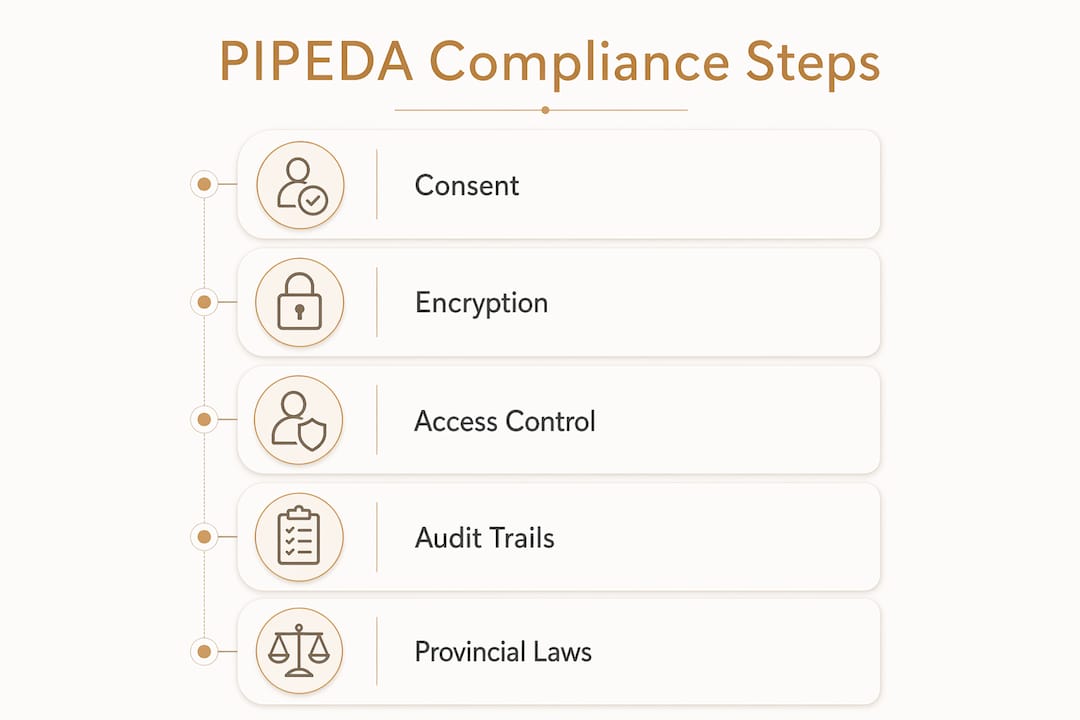
Technical safeguards under PIPEDA include encryption at rest and in transit, role-based access controls, and audit trails that log who accessed or changed a record and when. These are not suggestions. They are the minimum standard for demonstrating accountability under the Act.
How do you choose PIPEDA-compliant health record storage solutions?
The single most important criterion when evaluating any health data platform is data residency. Canadian data hosting is not explicitly mandated by PIPEDA, but it is the industry standard because it simplifies compliance with provincial laws and eliminates risks tied to foreign jurisdictions. Health data stored on US-based servers can fall under the US CLOUD Act, which allows American authorities to compel disclosure of data held by US companies, regardless of where the servers are physically located. That exposure directly conflicts with PIPEDA's safeguard requirements.
When evaluating platforms, prioritize these features:
- Canadian data residency: Servers physically located in Canada, confirmed in writing
- Encryption standards: AES-256 encryption at rest and TLS 1.2 or higher in transit
- Audit logging: Immutable logs of every access, edit, and export event
- Zero-retention AI policies: AI platforms must have zero-retention policies and explicitly exclude patient data from model training
- Written Data Processing Agreements: Mandatory DPAs under PHIPA and strongly recommended under PIPEDA for all vendor relationships
- Role-based access controls: Staff see only the data their role requires
Pro Tip: Ask every vendor for a copy of their Data Processing Agreement before signing any contract. If they cannot produce one, that is a compliance red flag.
Cost is a practical factor for smaller practices. Setup costs for PIPEDA-compliant AI and patient management systems for small Canadian clinics typically range from $2,500 to $4,000, with monthly fees of $399 to $599. That range reflects platforms that include encrypted record storage, AI-assisted intake, and audit logging. Budget-tier tools that fall below this range often cut corners on data residency or DPA documentation.
AI tools designed for clinical workflows can deliver real efficiency gains without sacrificing compliance. Compliant AI tools can generate diagnostic drafts or patient intake documents in under 45 minutes while maintaining strict Canadian data residency. The key is verifying that the AI vendor has zero-retention policies and does not use your patients' data to train its models.
How to implement secure health record storage in your practice
A structured implementation process prevents the compliance gaps that auditors find most often. The following steps apply to clinics deploying digital health record storage for the first time or migrating from paper-based systems.
-
Conduct a Privacy Impact Assessment (PIA). A thorough PIA must document patient data flow, AI usage, and all disclosure points to satisfy provincial audit requirements and PIPEDA obligations. Treat the PIA as a living document, not a one-time checkbox.
-
Obtain explicit patient consent. Draft consent forms that name the platform you use, where data is stored, and which third parties can access it. Verbal consent is insufficient for digital health records.
-
Define data governance policies. Assign a Privacy Officer, document data retention schedules, and specify which staff roles can access which record types. Role-based access controls must match your governance policy exactly.
-
Deploy infrastructure with Canadian data residency. Confirm server location in your vendor contract. Request a third-party security certification such as SOC 2 Type II or ISO 27001 as evidence of technical controls.
-
Establish audit trail procedures. Configure your platform to log every access and change event automatically. Review logs quarterly and retain them for the period your provincial law requires.
-
Build a breach response plan. PHIPA requires breach notification to the Information and Privacy Commissioner of Ontario within specific timeframes. Your plan must name the responsible staff member, define what constitutes a reportable breach, and document the notification process.
-
Schedule regular compliance audits and staff training. Privacy law evolves. Schedule annual reviews of your PIA, consent forms, and vendor agreements. Train all staff who handle patient records at least once per year.
The implementation process is not a one-time project. Clinics that treat it as an ongoing program maintain compliance far more reliably than those that set it up once and forget it.
What mistakes cause PIPEDA compliance failures in health record storage?
The most common compliance failure is storing patient data on platforms hosted outside Canada without patient disclosure. Many general-purpose cloud storage tools, including popular productivity suites, route data through US servers by default. That creates CLOUD Act exposure and likely violates PHIPA's data residency requirements, even if the clinic never intended to break the rules.
Relying on PIPEDA alone without checking provincial health information laws is the single most expensive compliance mistake a Canadian clinic can make. PHIPA, HIA, and Quebec's Law 25 each add requirements that PIPEDA does not cover, and regulators enforce them independently.
AI tool misuse is the second most common problem. Clinics sometimes connect patient data to general-purpose AI assistants that retain conversation history or use inputs for model training. That practice violates PIPEDA's safeguard principle and, in most provinces, constitutes an unauthorized disclosure of personal health information.
Inadequate audit trails create a third category of risk. Without logs showing who accessed a record and when, a clinic cannot demonstrate accountability during a regulatory investigation. Most enterprise health platforms generate these logs automatically, but entry-level tools often do not.
The practical fix for all three problems is the same: vet every tool against a written compliance checklist before deployment, not after. Retroactive remediation after a breach is far more expensive than prevention.
Key Takeaways
Storing health records in a PIPEDA-compliant manner requires Canadian data residency, meaningful patient consent, written vendor agreements, and audit trails that satisfy both federal and provincial regulators.
| Point | Details |
|---|---|
| Dual-layer compliance | Satisfy both PIPEDA and your provincial health information act, such as PHIPA or HIA, simultaneously. |
| Canadian data residency | Host patient data on Canadian servers to avoid US CLOUD Act exposure and simplify provincial compliance. |
| Mandatory consent and DPAs | Obtain explicit patient consent and signed Data Processing Agreements with every vendor before storing or sharing data. |
| Zero-retention AI policies | Use only AI tools that exclude patient data from model training and maintain no data retention after processing. |
| Ongoing audits and training | Review your Privacy Impact Assessment, consent forms, and vendor contracts annually and train staff every year. |
Why I think most clinics underestimate the provincial layer
Most compliance guides stop at PIPEDA. That is the wrong place to stop. In my experience working with Canadian healthcare providers, the federal law is actually the easier part. PIPEDA's ten principles are well-documented, and most reputable platforms address them. The harder challenge is the provincial layer, and that is where real compliance gaps appear.
Ontario's PHIPA, Alberta's HIA, and Quebec's Law 25 each impose requirements that go beyond what PIPEDA demands. PHIPA's data residency rules, for example, are not in PIPEDA at all. A clinic in Toronto that relies on a platform certified only for federal PIPEDA compliance may still be violating provincial law. That distinction costs clinics real money when regulators investigate.
The other thing I have seen clinics get wrong is treating the Privacy Impact Assessment as a document you file once and forget. Privacy law changes. AI tools change. Your vendor relationships change. A PIA that was accurate two years ago may not reflect how your clinic actually handles data today. The clinics that stay out of trouble are the ones that review their PIA every year and update it when anything changes.
My honest recommendation: find a platform that was built specifically for Canadian healthcare, confirm Canadian server hosting in writing, and get a signed DPA before you go live. The Acuros patient portal approach of launching in one day with no EMR migration is the right model for smaller clinics that cannot afford a six-month IT project. Speed to compliance matters as much as depth of compliance.
— Aryam
Acuros Health: PIPEDA-compliant records for Canadian clinics
Canadian clinics need a platform that handles compliance at the infrastructure level, not as an afterthought.

Acuros Health offers branded patient portals built specifically for Canadian clinics, with health records management designed to meet PIPEDA requirements and provincial privacy standards. The platform includes an AI health assistant that automates patient intake and health guidance while maintaining strict data privacy controls. Clinics go live in one day with no EMR migration required. Appointment booking, loyalty rewards, and secure record storage are consolidated in a single portal. If you are ready to move your practice to a compliant digital platform, book a consultation with the Acuros team today.
FAQ
What does PIPEDA require for storing health records?
PIPEDA requires meaningful patient consent, technical safeguards like encryption and access controls, and accountability through audit trails. Organizations must also limit data collection to what is necessary and protect data from unauthorized access or disclosure.
Does PIPEDA require health data to be stored in Canada?
PIPEDA does not explicitly mandate Canadian data hosting, but provincial laws like Ontario's PHIPA do require it. Hosting data in Canada is the industry standard because it eliminates US CLOUD Act exposure and simplifies compliance with provincial health information acts.
What is the penalty for violating PIPEDA or provincial health privacy laws?
Penalties vary by jurisdiction. Quebec's Law 25 allows fines up to C$25 million for mishandling sensitive personal information. Federal PIPEDA violations can result in public findings, compliance orders, and reputational damage that affects patient trust.
Do I need a Data Processing Agreement with my software vendor?
Yes. Written DPAs are mandatory under PHIPA for vendors acting as agents and strongly recommended under PIPEDA for all third-party data processors. A DPA defines the vendor's obligations to protect patient data and limits how they can use it.
Can I use AI tools for clinical documentation and stay PIPEDA compliant?
Yes, provided the AI platform has zero-retention policies, excludes patient data from model training, and stores data on Canadian servers. Compliant AI tools can produce diagnostic drafts and intake documents in under 45 minutes while meeting Canadian privacy requirements.