
PIPEDA compliance for clinics is the structured process of protecting patient personal information through adherence to Canada's federal privacy law and the ten Fair Information Principles that govern how personal data is collected, used, and disclosed. The Personal Information Protection and Electronic Documents Act applies to all commercial health practices in Canada, including private clinics, dental offices, and specialty care centers. Understanding how clinics achieve PIPEDA compliance means addressing three core pillars: administrative accountability, technical safeguards, and meaningful consent. The Office of the Privacy Commissioner of Canada (OPC) actively enforces these obligations. Non-compliance can result in penalties up to $100,000 CAD per violation, making this a financial and reputational priority for every clinic administrator.
What are the core administrative steps clinics must take to meet PIPEDA requirements?
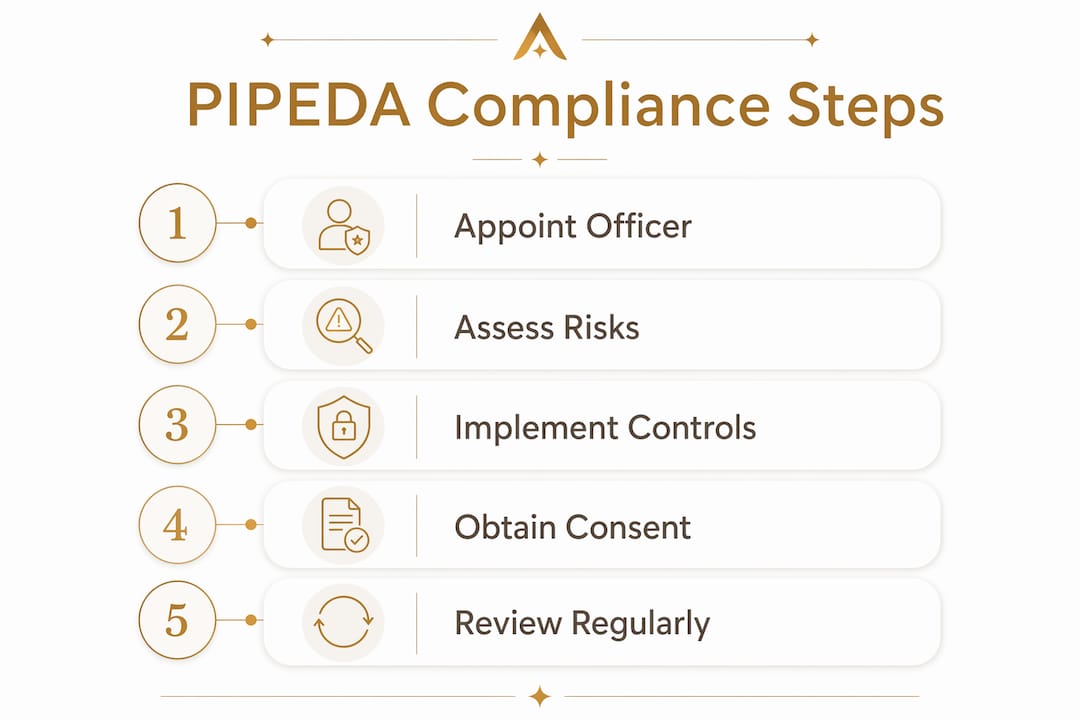
The foundation of PIPEDA compliance is accountability, and accountability starts with a named person. Every clinic must designate a Privacy Officer and document that appointment in writing. Small clinics must formalize this role themselves if no staff member has been formally assigned, establishing clear responsibility per PIPEDA's accountability principle. Without a named officer, no one owns the compliance process, and gaps multiply quickly.
Three administrative actions address the most common compliance gaps:
-
Designate a Privacy Officer. Write the appointment into your clinic's operating documents. This person handles access requests, breach responses, and staff training. The role does not require a legal degree, but it does require formal authority and documented responsibility.
-
Publish a clear Privacy Policy. Your policy must explain what data you collect, why you collect it, how long you keep it, and who can access it. Post it on your website and make a printed version available at reception. Vague language does not satisfy OPC standards.
-
Establish written incident response procedures. A breach response plan must exist before a breach occurs, not after. Clinics must retain breach records for 24 months and report breaches that pose a real risk of significant harm to the OPC promptly. Document who gets notified, in what order, and within what timeframe.
-
Set up an access request process. Patients have the right to request their personal information. PIPEDA requires clinics to respond within 30 days. Assign a staff member to log, track, and fulfill these requests consistently.
Pro Tip: Create a one-page internal reference card summarizing your Privacy Officer's contact details, breach reporting steps, and access request deadlines. Post it in the staff room. Compliance lives in daily habits, not binders.
These three administrative steps can be completed in less than one day and cover the most commonly cited regulatory gaps. Speed of setup matters less than consistency of execution.
What technical safeguards do clinics need to protect patient information?
Technical safeguards are the controls that prevent unauthorized access to patient data. PIPEDA does not prescribe specific technologies, but the OPC expects clinics to implement protections proportionate to the sensitivity of the data they hold. Health information is among the most sensitive categories recognized under Canadian privacy law.
The minimum technical controls every clinic should have in place:
- Encryption at rest and in transit. All patient records stored digitally must be encrypted. Any data transmitted over networks, including appointment confirmations and lab results, must use secure protocols such as TLS 1.2 or higher.
- Multi-factor authentication (MFA). Staff and administrators must use MFA to access any system containing patient data. A password alone is not sufficient protection for health records.
- Secure patient communication channels. Unsecured patient communications carry significant compliance risk. Standard email is not a compliant channel for transmitting personal health information. Dedicated encrypted patient portals reduce both breach risk and liability.
- Vendor and third-party risk management. Every software vendor, cloud provider, or third-party service that touches patient data must be reviewed for their own privacy and security practices. Require data processing agreements from all vendors.
- Audit logs and access monitoring. Log who accesses patient records, when, and from where. Review these logs regularly. Unexplained access patterns are often the first sign of a breach.
Technical controls must cover the entire communication and storage stack, including vendor policy reviews and regular penetration testing. A clinic that secures its own servers but ignores its billing software vendor has a gap that regulators will find.
Pro Tip: Schedule a quarterly vendor review. Pull up every third-party tool your clinic uses and confirm each one has a current data processing agreement and a published security policy. Outdated vendor arrangements are one of the most overlooked compliance risks in small clinics.

Two-factor authentication and encrypted storage simultaneously satisfy federal PIPEDA requirements and most provincial healthcare information security obligations. One technical investment covers multiple legal requirements.
How do clinics handle consent and patient rights under PIPEDA?
Consent is the operational center of PIPEDA compliance. Every collection, use, or disclosure of personal health information requires a legal basis, and for sensitive health data, that basis is almost always express consent. Meaningful consent must be obtained explicitly for sensitive health information. Vague or blanket consent at intake does not meet OPC standards.
Clinics that hand patients a dense intake form and ask them to sign at the bottom are not obtaining meaningful consent. They are collecting a signature. The distinction matters legally and practically.
A compliant consent process includes:
- Plain-language consent forms. Patients must understand what they are agreeing to. Use short sentences, avoid clinical abbreviations, and specify each purpose for data collection separately.
- Separate consent for sensitive uses. Sharing data with a specialist, using records for research, or sending marketing communications each require their own consent. Bundling these into one checkbox is not compliant.
- A documented withdrawal process. Patients must be able to withdraw consent at any time. Your clinic needs a clear procedure for honoring withdrawal requests and updating records accordingly.
- Access and correction rights. Patients can request their personal information and challenge its accuracy. Clinics must provide access within 30 days and correct inaccurate records promptly.
- A complaints process. Patients must know they can challenge your data practices. Include the OPC's contact information in your Privacy Policy so patients understand their escalation options.
Express consent for sensitive information is both a legal requirement and a trust-building tool. Patients who understand how their data is used are more likely to engage openly with their care team.
What special considerations apply to clinics under PIPEDA and provincial health laws?
PIPEDA is Canada's federal baseline, but most provinces have their own health information laws that apply simultaneously. Ontario clinics operate under the Personal Health Information Protection Act (PHIPA). Alberta clinics follow the Health Information Act (HIA). Quebec clinics must comply with Law 25, which introduced some of the strictest privacy requirements in Canadian history. British Columbia has its own Personal Information Protection Act (PIPA).
The interaction between federal and provincial law creates dual compliance obligations. The table below summarizes the key frameworks:
| Province | Primary Health Privacy Law | Key Distinction |
|---|---|---|
| Ontario | PHIPA | Applies to health information custodians; OPC defers to IPC Ontario |
| Alberta | HIA | Covers custodians and affiliates; Alberta OPC has independent authority |
| Quebec | Law 25 | Requires privacy impact assessments and mandatory breach notification |
| British Columbia | PIPA | Substantially similar to PIPEDA; OPC defers to BC OIPC |
| All others | PIPEDA | Federal law applies directly with OPC enforcement |
Clinics subject to both PIPEDA and provincial laws face dual reporting obligations for breaches. An Ontario clinic experiencing a breach may need to notify both the OPC and the Information and Privacy Commissioner of Ontario (IPC). Knowing which regulator to contact, and in what order, is not optional knowledge.
Incident response procedures need customization per regulatory body requirements, even when the underlying technical safeguards are shared. A single breach response plan that ignores provincial notification timelines will fail on the regulatory side even if the technical response is sound.
AI deployments in clinics require additional care: data must reside in Canada, audit trails must be maintained, and automated clinical decisions must be avoided to satisfy both PIPEDA and provincial laws. Clinics adopting AI tools should confirm Canadian data residency before going live.
Privacy impact assessments (PIAs) are the practical tool for mapping data flows to applicable laws. A PIA documents what data you collect, where it goes, who can access it, and which laws govern each step. Quebec's Law 25 makes PIAs mandatory for certain projects. Other provinces treat them as best practice. Every clinic should conduct one regardless of legal obligation.
Key Takeaways
Clinics achieve PIPEDA compliance by combining administrative accountability, technical safeguards, meaningful consent practices, and jurisdiction-specific breach reporting into a continuous operational commitment.
| Point | Details |
|---|---|
| Appoint a Privacy Officer | Document the appointment formally; this person owns all compliance responsibilities and breach responses. |
| Encrypt and authenticate | Use encryption at rest and in transit plus MFA for all staff accessing patient records. |
| Obtain express consent | Use plain-language, purpose-specific consent forms; blanket intake signatures do not meet OPC standards. |
| Know your provincial law | Ontario, Alberta, Quebec, and BC each add obligations on top of PIPEDA, including dual breach reporting. |
| Treat compliance as ongoing | Review vendor agreements, audit logs, and staff training quarterly, not annually. |
Why I think clinics underestimate the operational side of PIPEDA
Most clinic administrators I have spoken with treat PIPEDA compliance as a documentation project. They update their Privacy Policy, designate a Privacy Officer on paper, and consider the job done. Viewing PIPEDA as a one-time policy update is the most common and most costly mistake. Compliance is an operating manual for daily data handling, not a filing cabinet item.
The risks that actually bite clinics are operational. A receptionist who emails a patient's lab results without encryption. A billing software vendor whose data processing agreement expired two years ago. A consent form that has not been updated since the clinic opened. These are not policy failures. They are workflow failures.
The other underestimated risk is email. Clinics default to email for patient communication because it is convenient. Centralizing patient data in encrypted portals reduces breach risk and compliance exposure far more than any policy document. The technology investment pays for itself the first time it prevents a reportable incident.
My honest advice: build compliance into your clinic's weekly rhythm. Review one vendor agreement per month. Run a staff training session every quarter. Treat your Privacy Policy as a living document that reflects your actual data practices, not an aspirational statement. The OPC closed 1,317 PIPEDA complaints in 2024–2025. Active enforcement is not a future concern. It is the present reality.
— Aryam
How Acuros Health supports PIPEDA-compliant clinic operations
Canadian clinics that want to reduce compliance risk without adding administrative overhead have a practical option in Acuros Health.

Acuros offers a branded patient portal built specifically for Canadian clinics, consolidating appointment booking, patient communication, loyalty rewards, and health guidance into a single secure environment. Every record in the platform is designed to meet PIPEDA compliance requirements, removing the patchwork of unsecured email threads and disconnected tools that create breach exposure. The AI Health Assistant is built with Canadian data residency and audit trail requirements in mind, addressing the specialized compliance demands that AI deployments face under both PIPEDA and provincial health laws. Acuros goes live in one day with no EMR migration required, so your clinic gains a compliant infrastructure without a lengthy technical project.
FAQ
What is PIPEDA compliance for clinics?
PIPEDA compliance means a clinic collects, uses, and discloses patient personal information according to Canada's ten Fair Information Principles, with accountability, meaningful consent, and appropriate safeguards as the core requirements.
How does a clinic designate a Privacy Officer under PIPEDA?
A clinic designates a Privacy Officer by formally documenting the appointment in writing, assigning that person authority over access requests, breach responses, and staff privacy training.
What counts as meaningful consent under PIPEDA?
Meaningful consent requires patients to understand what data is collected, why it is collected, and how it will be used, with express consent required for sensitive health information. Blanket intake signatures do not meet this standard.
Do clinics need to comply with both PIPEDA and provincial health laws?
Yes. Ontario clinics follow PHIPA, Alberta clinics follow the HIA, and Quebec clinics follow Law 25, all in addition to PIPEDA. Breaches may require notification to both the OPC and a provincial regulator simultaneously.
How long must clinics keep breach records under PIPEDA?
PIPEDA requires clinics to retain records of all privacy breaches for a minimum of 24 months and to report breaches posing a real risk of significant harm to the OPC promptly after discovery.